Time and procrastination
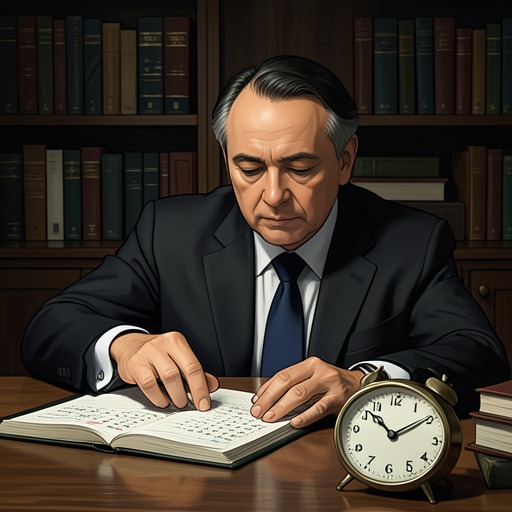
The KillerTime and procrastination gives temporal pressure a dramatic shape: Berenger the First tries to command time only when it has run out, while Queen Marguerite explains that his crisis was prepared by years of deferral. The play opposes his wish to recover the past to her insistence that time cannot be reclaimed, then makes the remaining hour both an absolute limit and a measure of what sustained attention might have achieved.
The attempted reversal of time
The subject emerges in a ceremony staged around the King’s impending death. Berenger the First, seated on his throne with Queen Marie beside him, asks, “Let time turn back in its tracks.” Queen Marie joins the wish, first imagining them as they were twenty years earlier, then calling for time to return to last week and yesterday evening. The movement through these intervals makes their appeal increasingly immediate: rather than accepting the present, they search backwards for a point at which the ending might still be avoided.
Queen Marguerite answers that the time for such a reversal is gone: “There is no more time. Time has melted in his hands.” The image turns an abstraction into something irretrievably spent. Time has not merely passed around the King; it has escaped his grasp. The Doctor’s telescope supplies a strikingly different measure from the queens’ personal memories. Looking through it, he reports a gap in the sky where the Royal Constellation used to be and says that, in the annals of the universe, Berenger the First has been entered as deceased. The Guard’s ensuing announcement, “The King is dead! Long live the King!”, gives the private struggle a public and ceremonial form. The sequence places backward-looking desire beside an impersonal record that already names the King’s death.
A life organized around postponement
Queen Marguerite presents the King’s failure not as a single missed opportunity but as a repeated habit. She says he had been warned, and argues that he should have prepared by giving death a small, regular portion of his attention: five minutes each day, then ten, a quarter of an hour, and eventually half an hour. Her proposed increments make preparation itself a practice. The point is not that a few minutes could have stopped death, but that facing it gradually would have been different from meeting it unprepared at the end.
Berenger the First replies that he did think about death. Queen Marguerite rejects the claim as insufficient: he did not think seriously or profoundly, or with all his heart and soul. Her distinction is between having an idea of mortality and allowing that knowledge to alter how one lives. The King’s own protest—that he was full of life at forty—helps expose the mechanism of delay. At fifty, he wanted to reach his sixties; later he deferred the reckoning through increasingly extravagant spans, from sixty to ninety, a hundred and twenty-five, two hundred, and finally four hundred years. The postponement expands from decades into centuries, so that every apparent extension only carries the encounter further into an imagined future.
The last hour as a measure
When Berenger the First says he was just about to begin and wishes for a whole century, the Doctor answers with the actual limit: “All you have now is one hour, Sire.” The contrast is severe. The King has imagined that a vastly extended future would finally permit him to start; the hour makes clear that no such guarantee follows from having more time. Queen Marie calls the allotment impossible and says he must be given more. Queen Marguerite counters that an hour gives him all the time he needs.
The Doctor develops that counterargument by setting a well-spent hour against centuries of neglect and failure. He counts the allowance precisely as sixty minutes and three thousand six hundred seconds, then calls the King lucky. The precision does not erase the limit; it makes the limit newly legible. An hour cannot restore the years that were deferred, yet the Doctor insists that attentive use matters more than duration alone, down to “ten fully conscious seconds.” Time therefore has two opposing meanings in the scene: an accumulating quantity that the King kept assuming he could enlarge, and a finite present whose value depends on whether it is consciously inhabited.
Dramatic meaning
The scene’s progression—from a plea to reverse time, through Queen Marguerite’s account of habitual delay, to the Doctor’s arithmetic of the final hour—turns procrastination into more than a personal miscalculation. The King’s repeated assumption that there will be another interval postpones not only a particular task but the encounter with mortality itself. His wish for a century at the moment when only an hour remains makes the gap between imagined time and available time visible.
The exchanges also resist a simple equation between having time and using it well. Queen Marie’s plea for more time expresses the emotional refusal to accept a limit, while Queen Marguerite’s answer insists that the limit cannot be negotiated away. The Doctor’s calculation offers neither renewed life nor recovered centuries; it reframes the remaining duration as an opportunity for awareness. In this way, time and procrastination is defined by a double pressure: the irreversible loss of what has been put off, and the demand to attend fully to what remains.